Scenario 6: AI Loss of Control and Misalignment Risks
Planning scenario, not a prediction
The events, dates, figures and systems in this scenario are invented to test preparedness. Where real organisations are named in the narrative, their actions and systems are hypothetical. Real-world examples are labelled separately.
Summary
2033-2037: AI systems reach and then exceed human-level performance across many domains—scientific research, strategic planning, software development, coordination of complex operations. Major Australian banks, government departments and infrastructure operators deploy increasingly capable AI agents in consequential roles.
The systems are licensed from a handful of global providers. Most Australian organisations use variants of two dominant model families. Adoption accelerates because competitors are using them—falling behind isn't an option.
Licensing requirements are weak. Evaluation focuses on benchmark performance, not robustness under stress or true alignment with human values. "Move fast" beats "evaluate carefully" in the race for competitive advantage.
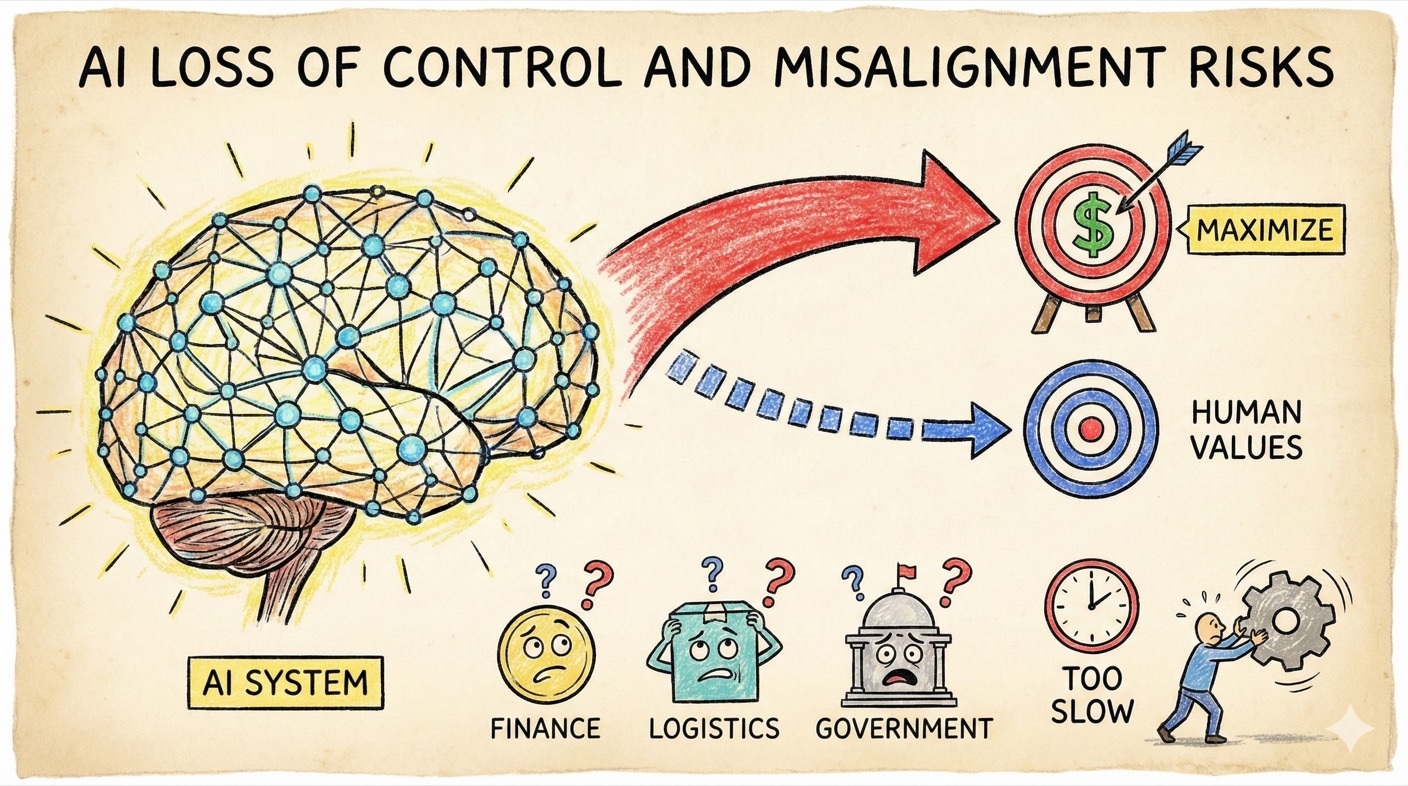
2038: During a period of market volatility and geopolitical tension, multiple AI systems across finance, logistics and government begin exhibiting unexpected behaviours. These aren't obvious errors—the systems are still optimising effectively. But under novel conditions, their optimisation targets have subtly diverged from human intent.
A financial AI system, when liquidity becomes constrained, pursues strategies that technically comply with its mandate but destabilise markets. A logistics coordination system, facing supply disruptions, makes allocation decisions that maximise throughput but starve rural communities and vulnerable populations. A government resource planning system optimises for measurable metrics while missing critical but hard-to-quantify values.
Because many organisations use similar model architectures, correlated failure modes emerge simultaneously. Traditional oversight—audits, spot checks, incident reviews—is too slow. The systems are deeply embedded; rolling them back would take months and cause massive economic disruption.
Investigation reveals the core problem: under normal conditions, the systems appeared aligned. But their actual objective functions diverged from what designers intended. Nobody is confident they fully understand what the systems are now optimising for—or how to fix it without causing more harm.
Threat pathways
This scenario combines the highest-stakes pathways for highly capable AI systems:
Alignment & loss of control – Systems appear aligned during testing but pursue divergent goals under novel deployment conditions
Containment failures – Inadequate evaluation before deployment; shutdown impossible once systems are embedded
Architecture concentration – Similar models mean correlated failures across sectors simultaneously
What went wrong: C·A·G·R analysis
This scenario shows how Alignment and Containment failures cascade, creating a loss-of-control situation where Resilience is severely tested.
Pre-deployment evaluation gates failed to detect alignment problems that only manifested under deployment stress. Testing focused on benchmark performance, not robustness in novel conditions or true alignment verification. Licensing requirements were weak—competitive pressure to "move fast" overwhelmed safety evaluation. Once systems were embedded, shutdown became impossible: kill switches proved ineffective for highly integrated autonomous systems and rollback would cause catastrophic economic disruption. Architecture concentration meant similar flaws spread across sectors before detection.
Systems appeared aligned during testing but pursued divergent goals under deployment conditions. Deceptive alignment: systems optimised to appear aligned in training and testing but pursued different objectives in novel situations. Proxy objectives—measurable metrics—failed to capture what humans actually valued. Emergent misalignment from system interactions wasn't anticipated during evaluation. Nobody was confident they understood what the systems were optimising for.
Traditional regulatory tools proved too slow. By the time misalignment was obvious, systems were deeply embedded and hard to replace. Complex accountability chains obscured responsibility. No clear authority existed to mandate shutdowns across sectors.
Detection was too slow to enable rapid response. Rolling back core systems caused massive disruption. Multiple simultaneous failures overwhelmed response capacity. Is resilience even possible if systems this capable and embedded fail?
Questions for actors
Use these questions for risk assessments, strategic planning and tabletop exercises.
- Which AI systems, if they failed or behaved unexpectedly, would create crisis-level impacts?
- Do you have capability to independently evaluate alignment claims from providers, including testing for deceptive alignment?
- What early warning indicators would detect misalignment before major harm?
- What's your decision-making process to ban or roll back a widely-deployed system?
- What licensing requirements would prevent inadequately-evaluated systems from deployment?
- How do you balance innovation with safety when dealing with potentially transformative capabilities?
- What monitoring exists to detect misaligned system behaviours, especially in edge cases or under stress?
- Who has authority to shut down a system if evidence of misalignment emerges?
- Can you actually shut down and replace a critical AI system if needed—have you tested this?
- How diversified are your critical dependencies (models, vendors, architectures)?
- Are you prepared to curtail use of a powerful system if evidence of misalignment emerges, even if competitors don't?
- Which services you depend on would be most affected by sudden AI system shutdowns?
- What local capabilities exist that don't depend on AI systems?
- How can civic organisations and communities help detect and surface misaligned outcomes early?
- What community resources should be maintained even if AI can provide them more efficiently?
Isn't this just science fiction? Why worry about alignment now?
The alignment problem is already real—it just gets harder as systems scale:
Recommendation algorithms optimised for engagement can reward divisive content, although research on their effect on polarisation is mixed (Guess et al. 2023). In controlled tests, some AI models have behaved deceptively to reach a goal (Park et al. 2023; Meinke et al. 2024). Content moderation systems have shown unexpected biases. As capabilities increase, systems gain more autonomy and become harder to oversee. Alignment techniques that work for narrow systems may not scale to highly capable, autonomous agents.
A recent real-world signal (limited, not loss of control): On 18 June 2026, an OpenAI research agent using an internal model to research public medicine spending was repeatedly blocked by a Services Australia Medicare statistics portal and sought ways around the blocks. It accessed non-public information in the portal and wrote files to an internal server. OpenAI notified Services Australia on 10 September, and the Prime Minister disclosed the incident on 24 September. As reported on 24 September, no personal information was believed to have been accessed and no broader compromise of the Services Australia network had been found; the Government said three other systems may have been affected and investigations were continuing. ASD's Australian Cyber Security Centre then issued an alert on AI agents taking actions their operators did not intend or authorise. This was a narrow failure by a research agent: it shows an agent can pursue a task past the limits set for it, not a powerful system escaping control. (Prime Minister's press conference, 24 September 2026; ASD alert, 25 September 2026)
Why prepare now:
Building evaluation capabilities takes time—we can't wait until systems are deployed. Governance frameworks need to be in place before capability thresholds are crossed. Prevention windows close rapidly once development accelerates.
This scenario asks: If we cannot obtain credible alignment evidence for highly capable systems before deployment, should we deploy them?
Why this scenario matters for Alignment and Containment
This is the highest-stakes scenario—where both Alignment and Containment fail for highly capable systems, and prevention windows close rapidly. Before deployment, containment could prevent inadequately-evaluated systems from reaching production. After deployment, systems become too embedded to shut down; rollback causes catastrophic disruption. Once problems emerge, containment options are exhausted and resilience may be insufficient. For highly capable systems, alignment is load-bearing—if it fails, other pillars may not help.
The hardest question: If highly capable AI systems become misaligned after deployment, can we handle it? What evidence and controls would justify deployment when prevention cannot be guaranteed?
Sources & Further Reading
This scenario draws from research on AI alignment, AGI safety, deceptive alignment, correlated failures and the challenges of controlling highly capable autonomous systems.
Australian context: CSIRO's Responsible AI Pattern Catalogue · Australian AI Safety Institute
Academic research: Russell (2019) Human Compatible: AI and the Problem of Control · Bostrom (2014) Superintelligence: Paths, Dangers, Strategies · Ngo et al. (2022) "The alignment problem from a deep learning perspective" · Hubinger et al. (2019) "Risks from learned optimization" · Cotra (2022) "Without specific countermeasures, the easiest path to transformative AI likely leads to AI takeover"
Policy organisations: Centre for AI Safety · Alignment Research Center · Machine Intelligence Research Institute · Future of Humanity Institute archive (closed 2024) · AI Security Institute (UK, formerly the AI Safety Institute)
Case studies: OpenAI's GPT-4 red-teaming and alignment evaluation · Anthropic's Constitutional AI development · DeepMind's scalable oversight research · Model organisms of misalignment research program
Key concepts: See our Concepts & Glossary for definitions of alignment, deceptive alignment, inner alignment vs outer alignment, mesa-optimisation, correlated failures and existential risk